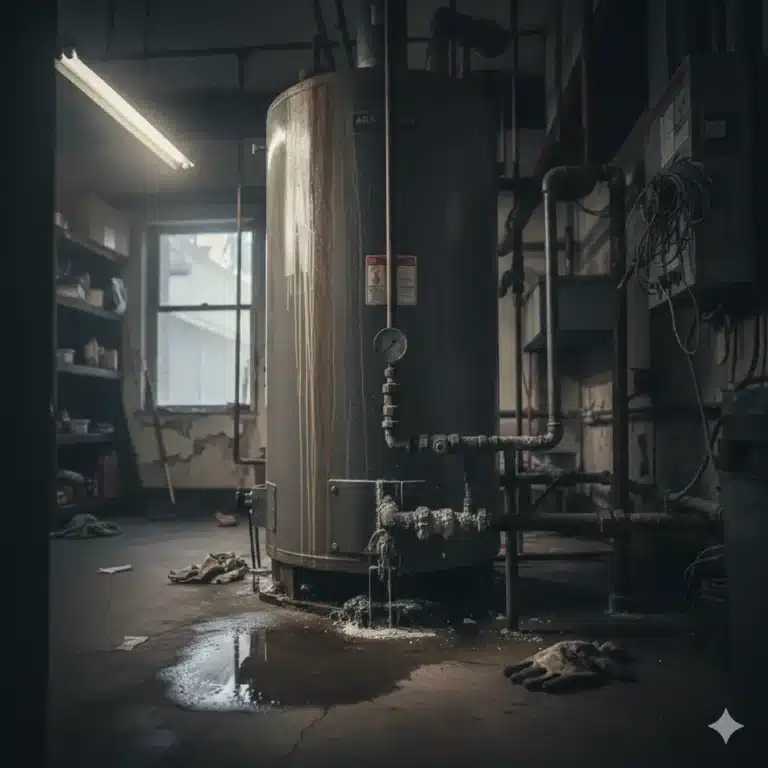
If your tank has started popping and rumbling, how to flush water heater sediment out is the right question, but there is one thing to check before you touch the drain valve. On an older Vista tank that has never been flushed, opening that valve is how a working water heater becomes a leaking one.
Why Vista Water Heaters Fill With Sediment So Fast
You already know the symptoms. Hot water takes longer to show up, runs out sooner than it used to, and the tank pops or rumbles like a kettle when the burner fires. Sometimes the hot side runs cloudy or gritty.
Here is what is happening inside. North County runs on mineral-heavy water, and the signs of hard water in your North County home show up in the water heater first. Those dissolved minerals drop out of solution when the water is heated, then settle on the floor of the tank as a layer of sediment.
That layer causes two problems. It insulates the burner from the water above it, so the tank works harder for the same shower. And water trapped underneath flashes to steam and forces its way up through the crust, which is the popping you hear.
Flushing is maintenance, not repair. On a healthy tank it buys back efficiency and adds years. On a tank that is already failing, it fixes nothing, and it can move the failure from next spring to tonight.
What to Have on Hand Before You Flush a Water Heater
Before anything else, kill the heat. Gas goes to pilot or vacation setting, electric gets its breaker shut off at the panel. Never drain an electric tank with the elements powered, because an element that fires dry is ruined in seconds.
Then gather:
- A garden hose long enough to reach a driveway drain or a downslope area
- A flathead screwdriver or a valve key for the drain valve
- A bucket, in case the hose connection weeps
- Work gloves and closed shoes
- About an hour when nobody needs hot water
Know where your shutoffs are before you start. There is a cold supply valve on top of the tank, and the main house shutoff is your backup.
The water coming out is hot enough to scald and it has to go somewhere safe. August ground here is dry and hard, so route the hose to a drain instead of into planting beds.
Rather have someone look at the tank first? Get in touch for a free, no-obligation estimate.
How to Flush Water Heater Sediment, Step by Step
Step 1: Kill the heat and let the tank cool
Gas goes to pilot or vacation. Electric goes off at the breaker. Then give the tank thirty to sixty minutes so the water inside is warm instead of scalding. Skipping the cool-down is the most common way people get hurt doing this job.
Step 2: Shut the cold supply and open a hot tap
Close the cold inlet valve at the top of the tank, then open a hot faucet somewhere in the house. That second step breaks the vacuum so the tank can actually drain. If you reach step four and nothing comes out of the hose, this is almost always why.
Step 3: Connect the hose and open the drain valve slowly
Thread the hose onto the drain valve at the bottom of the tank and run it to your discharge point. Then open the valve slowly. Slowly matters. Snapping it wide open can pull a slug of sediment into the valve seat and jam it partly open, which turns an hour of maintenance into a service call.
Step 4: Watch what comes out
The first flow is often cloudy, rusty or full of grit, and that is the point. Let it run until the water leaving the hose looks like the water going into the house. Note two things while you watch: chunks of hard scale, and a flow that slows to a trickle on its own. Both matter for the next section.
Step 5: Stir the bottom with a short burst of cold
With the drain still open, briefly open the cold supply to agitate the sediment on the tank floor, then shut it again and let the tank drain. Repeat two or three times until the discharge runs clear. This is the step that separates a real flush from a partial drain, and it is the one most people skip.
Step 6: Close up, refill, then restore the heat
Close the drain valve, pull the hose, and reopen the cold supply. Leave that hot tap running until the air stops sputtering and flow is steady, which tells you the tank is full. Only then relight the pilot or flip the breaker back on, because heating a partly empty electric tank destroys the elements. Check the drain valve for weeping over the next day.
When Not to Flush: Stop and Call Instead
Here is the part most flush guides leave out. On a tank that has never been flushed and is well past its warranty years, that sediment layer is sometimes the only thing sitting over a corroded spot on the tank floor. Drain it away and the corrosion has nothing left to hide behind. A heater that was fine Saturday morning is leaking across the garage floor Sunday night.
Stop and call instead if any of these are true:
- The tank has never been flushed and you do not know how old it is
- There is already rust-colored water or moisture around the base
- The drain valve will not close fully once you have opened it
- Flow slows to nothing partway through the flush
- The temperature and pressure relief valve is weeping
Also stop if the tank has reached the point where repairs keep repeating. At that point it is a repair or replace decision, not a maintenance one, and a leaking tank is the most common water heater failure we get called out for.
Our water heater repair and installation work starts with assessing the tank, then we flush it, replace a failed drain valve, or tell you straight that flushing is not worth the risk on that unit. No upsell and no pressure. You get a free, no-obligation estimate and an upfront price before any work starts. Get in touch. We work throughout Vista, Oceanside, Carlsbad, Escondido, San Marcos and Encinitas.
Frequently Asked Questions
Q: How often should you flush a water heater with hard water?
A: Once a year is the working rule in North County, and twice a year is not unreasonable on a busy household’s tank. Mineral-heavy water builds sediment faster than most manuals assume. If it has been several years, have the tank looked at first.
Q: Can flushing a water heater cause a leak?
A: Yes, on an older tank that has never been flushed. Sediment can sit on top of a corroded section of the tank floor, and removing it exposes thin steel to full pressure. That is why age and condition get checked before the drain valve gets opened.
Q: Is it too late to flush a water heater that has never been flushed?
A: Often, yes. A tank well into its later years that has never been drained is the exact case where a flush triggers a leak. Have it assessed first, because if it is close to the end anyway the money is better spent planning the replacement.
Q: Do tankless water heaters need to be flushed too?
A: Yes, though the job is different. Tankless units get descaled by circulating a cleaning solution through the heat exchanger with a pump, not by draining a tank. In mineral-heavy water they need it on a schedule, and skipping it costs efficiency first and the unit later.
Get It Looked At Before It Becomes a Replacement
That popping sound is sediment telling you the tank is working harder than it should. Sometimes the fix is an hour with a garden hose. Sometimes it is a tank that needs assessing before anyone opens a valve. Get in touch for a free, no-obligation estimate in Vista, Oceanside, Carlsbad, Escondido, San Marcos or Encinitas.